
Panel: Can a Flying Bed Solve the Housing Crisis?
"A student can live well in twelve square meters, but as soon as graduation comes, it suddenly takes three times as much space to live a good life. Is that limit based on technical justification, or just habit?"
This thought-provoking question, posed by developer Anders Buchardt of AB Invest, kicked off a major debate during Arendalsuka on August 11. Aboard the MS Brisen, the startup MASE Home gathered some of the heaviest hitters in Norwegian real estate to ask a simple, yet unconventional question: Is the industry thinking enough about technology and design to get more out of every square meter?

Anders Buchardt (AB INVEST), Tone Tellevik Dahl (NORSK EIENDOM), Thomas Børnish (SKANSKA), and Marianne Gjertsen Ebbesen (OBOS)
Rethinking Square Footage
The debate featured a prominent panel including executives from OBOS, Skanska, Norsk Eiendom, AB Invest, SiO, Nordvik Bolig, and OBOS Living Lab. A key focus of the discussion was OBOS Living Lab’s "Bo Kompakt" project, which studies how high living quality can be achieved in spaces under 35 square meters.
Søren Secher and Susanne Sekkesæter, who opened the debate, made one thing clear: a home is only "too small" when you are forced to compromise on essential functions and flexibility. "We have shown that living quality does not depend on square footage alone," Sekkesæter stated.
Breaking Free from "Space Fascism"
Developers on the panel admitted that during the recent boom years, the industry was too short-term minded, focusing heavily on square meters rather than the actual content of the homes. Because almost everything sold easily, there was little financial incentive to innovate or rethink traditional layouts.
However, the industry isn't the only hurdle. There was broad consensus that strict municipal regulations make it incredibly difficult to build affordable housing for first-time buyers. Tone Tellevik Dahl of Norsk Eiendom urged politicians to focus on health and safety rather than rigid size requirements.
"Don't claim that 35 square meters and up is the sole truth for a good life. We must get away from that space fascism," she said. According to a recent survey, around 40 percent of municipalities in Eastern Norway have mandates that set minimum apartment size requirements.
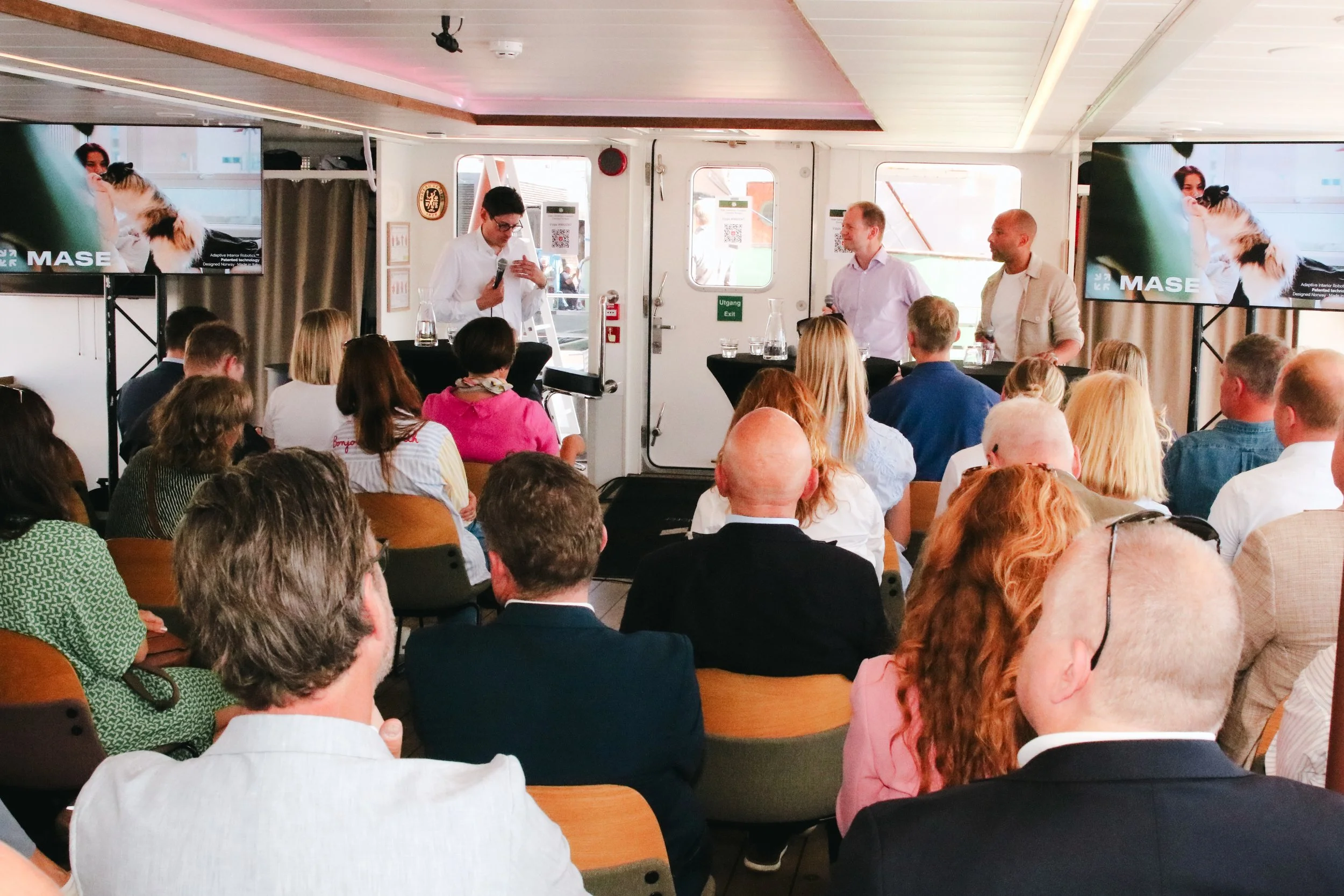
Andreas Eskelund (SiO), Martin A. Kiligitto (NORDVIK)
The Home of 2050 is Already Here
When asked what a home for a 25-year-old will look like in 2050, the panel suggested that affordability will force a shift. To combat rising costs, resource scarcity, and climate concerns, future homes will likely need to be smaller, rely more on shared amenities, and heavily incorporate space-saving technology.
But according to MASE Home, we don't have to wait until 2050. In her closing remarks, Sekkesæter emphasized that their robotic furniture—which literally lifts beds out of the way to free up floor space—is ready for the market.
"These solutions are not at a pilot stage. This is technology that exists and can be deployed in projects today," she stated, noting strong results for both resident living quality and developer cost savings.